


- 商品
- 費用・目的
- 選ばれる理由
- 納入事例
- お役立ち情報
- 建物オーナー、管理者様、設計施工ご担当者様へ
- 壁面緑化
- 事業内容・運営会社
キリンソウと四季の彩り日記屋上緑化システム株式会社
技術顧問 山下 律正
<技術レポート> 白花セダムの開発史 キメラ枝からの白花種開発 Development History of White-Flowered Sedum
<技術レポート>
白花セダムの開発史 キメラ枝からの白花種開発
<Technical Report>
Development History of White-Flowered Sedum: Development of white-flowered varieties from chimera branches
タケシマキリンソウの白花開発史は前号で紹介したが、セダム種での開発も実施した。
2020年まで屋上緑化やグランドカバープランツの主流で有ったセダム類においても花色は黄色(一部は白とピンク色種があり)が市場流通品種の主流で有り変異種の要望があった。
同一種の中に花色の異なる変異種が存在しないセダム種では未だ花色の新品種は発表されていない。
しかし、研究は行われておりその歴史はキリンソウの白花開発より古く2007年ごろまで遡る。
白花開発は化学突然変異による新品種作成の2次的なもので、ここでも多くの場合、初期的なスクーリングで草姿の未変化試験体は廃棄され開花期まで保管されていなかった事が発見を遅らせる結果となっていた。
開発手法の中に成長新芽に散布する散布法で行った圃場栽培植物に対して実施した試験において変異例があるので紹介する。
これまでは切り取った試験枝を直接変異試薬に漬けて処理を行う浸漬法で試験を行っていた。この方法では試験条件を順守する事が出来再現性が高く実用性に優れていた。
文献より処理法について検討すると(転載:突然変異育種 1.4突然変異体の選抜 5)
突然変異薬の感受性要因は、水溶液浸漬で処理する事が有利な事は気乾種子にくらべ感受性が高い点にある。水溶液浸漬の感受性が高い作用機構は、水から作られる遊離基や-OH H2O2は酵素との相互作用により変異の一部を負担する。水分含有量が高いと遊離基の活性度が低下する。非常に乾燥した環境(15~20%の水分量)では遊離基が長時間維持するなどが上げられる。
試薬の作用温度は、植物生体においては8葉時期から花芽分化時期が良く、20℃以下より61℃に上昇するにつれ障害は小さくなる。と紹介されているが、栄養繁殖体では20度以下で処理しないと成体の生理バランスが不全となり枯死に至る。
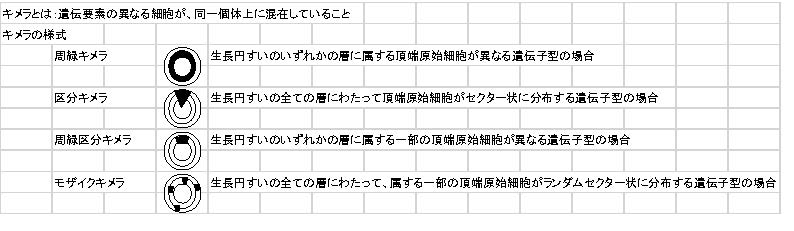
栄養繁殖植物においては、体細胞突然変異を利用する遺伝的変異の誘発した突然変異細胞は、多くの場合非突然変異細胞からなる組織中にキメラ状に保有される。
キメラ状となる原因は、半染色分体単位で起こる突然変異によるモザイクの形成、生長点組織のtunica層間の転換が実例として明らかになっている。
The history of developing white-flowered varieties of (Sedum takesimense Nakai) Phedimus takesimensis was introduced in the previous issue, but development has also been carried out in other Sedum species.
Even among Sedum mexicanum, which were the mainstream for rooftop greening and ground cover plants until 2020, the flower color was predominantly yellow (with some white and pink varieties), and there was a demand for variant varieties.However, research has been conducted, and its history predates the development of white-flowered (Sedum takesimense Nakai) Phedimus takesimensis, dating back to around 2007.The development of white-flowered varieties was a secondary process of creating new varieties through chemical mutation. Here again, in many cases, the unchanged test specimens were discarded during the initial screening and not stored until the flowering period, which delayed the discovery.This section describes mutation examples observed in field-grown plants treated using a spraying method applied to growing shoots as part of the development process.
Previously, testing was conducted using the immersion method, where cut test branches were directly immersed in the mutagenic agent. This method allowed for adherence to test conditions, offered high reproducibility, and was highly practical.A review of the treatment method from the literature (reprinted from: Mutation Breeding, 1.4 Selection of Mutagenic Agents, 5)
The susceptibility factors of mutagenic agents include:The advantage of treatment by aqueous solution immersion lies in its higher susceptibility compared to air-dried seeds.The mechanism of action for high susceptibility with aqueous solution immersion is that free radicals and -OH H2O2 produced from water contribute to the mutation through interaction with enzymes.
High water content reduces the activity of free radicals.In very dry environments (15-20% water content), free radicals are maintained for a long time.These are some of the factors mentioned.
The reagent’s action temperature is described as being optimal for living plants from the 8-leaf stage to flower bud differentiation, with damage decreasing as the temperature rises from below 20°C to 61°C. However, in vegetatively propagated plants, treatment below 20°C is necessary to prevent physiological imbalance in adult plants, leading to death.
In vegetatively propagated plants, mutant cells induced by somatic mutations are often present in a chimeric manner within tissues composed of non-mutant cells.
The causes of chimeric formation have been clarified through examples such as mosaic formation due to mutations occurring at the semichromatid level and the transition between tunica layers in germination tissue.
(転載:突然変異育種 3,4,1突然変異体の選抜 70)(Reprinted from: Mutation Breeding 3,4,1 Selection of Mutants 70)
突然変異が生じるにしても1つの細胞で同時に2個以上の離れた遺伝子座で突然変異が生じることは極めて希である。そのため材料に既存の優良品種を用いて突然変異誘発処理を加えた場合、有る特定の形質が良い方に突然変異すると、他の形質は元のままなので突然変異した形質が良くなった分原品種より優れた品種となる。遺伝的にヘテロの割合が高い分だけ栄養繁殖性作物では、処理当初の表現型が突然変異した細胞のみからなる。体細胞突然変異として出現する。そしてこのような突然変異が芽条変異(枝変り)のように増殖可能の形で出現すれば、これを用いて栄養繁殖する事が可能で容易に新品種を作出できる。遺伝的にヘテロの割合が高い分だけ栄養繁殖性作物では、処理当初の表現型が突然変異した細胞のみからなる体細胞突然変異として出現する。そしてこのような突然変異が芽条変異(枝変り)のように増殖可能の形で出現すれば、これを用いて栄養繁殖する事が可能で容易に新品種を作出できる。
(転載:突然変異育種 5,1,1突然変異体の選抜 120)
突然変異してアルビナ(albina)キサンタ(xantha)などの葉緑素突然変異を発生した枝では、葉腋から伸長する枝は完全な枝分かれとなる場合が多い。生長点が区分キメラになっていても、ある葉腋の芽がその区分キメラのセクター上に完全に乗っていれば、その生長点が伸長すると完全枝変りとなる。
(転載:突然変異育種 5,1,2突然変異体の選抜 122)
しかし、湿潤式処理法では試験体の処理量に限界があり1回に数百単位が限界となっていた。より大量に処理し変異体を作るために、圃場畝に植栽している数百株に散布する方式で実験を行った例がある。大量に処理できる反面、日射、天候、風等の自然条件に左右され突然変異源の作用が乱れ、再現率は悪く草姿の変異は皆無に近い成果となった。しかし花色などの1年単位の長期で見ると変異体の発生が認められた。
メキシコマンネングサへの実施例
2007年圃場畝に植栽している数百株に対し噴霧処理法により実験を実施、メキシコマンネングサのキメラ枝を作成し、キメラ枝からの開花の手法を用いて白花を作成した。
キメラ枝による白花の作成は、方法的には発生率が高く実用的ではあるが、欠点としてキメラ枝自体は光合成しない事から正常な緑色枝が株中に混在すキメラ混在株させる事が必要である。
遺伝子的にはこの特性はクローン遺伝が可能であるが、遺伝子の自己修復で3世代~5世代でキメラは消滅しやすい。
花序からの全花の白花は、緑葉色が退色し黄緑色に変化しても、黄色花色が連動して白色化する事は無く、完全キメラによるのみ可能となり葉色と花色の連動性は至っていない。
花序の部分開花が白色化する事は、この現象と異なる方法で発生しており実例が発生している。
Even when mutations occur, it is extremely rare for mutations to occur simultaneously in two or more distant gene loci within a single cell. Therefore, when an existing superior variety is used as material and subjected to mutagenesis treatment, if a specific trait mutates in a positive direction, other traits remain unchanged, resulting in a variety superior to the original variety due to the improvement in the mutated trait.In vegetatively propagated crops, where the proportion of heterozygotes is high, the initial phenotype after treatment consists only of mutated cells. This appears as a somatic mutation. If such mutations appear in a form that can be propagated, such as bud mutations (branch mutations), they can be used for vegetative propagation, easily creating new varieties.In vegetatively propagated crops, where the proportion of heterozygotes is high, the initial phenotype after treatment appears as a somatic mutation consisting only of mutated cells. If such mutations appear in a form that can be propagated, such as bud mutations (branch mutations), they can be used for vegetative propagation, easily creating new varieties. (Reprinted from: Mutation Breeding 5,1,1 Selection of Mutants 120)
In branches that have undergone mutation and developed chlorophyll mutations such as albina and xantha, branches extending from the leaf axils often exhibit complete branching. Even if the growing point is a segmented chimera, if a bud in a certain leaf axil is completely situated on the segmented chimera sector, the elongation of that growing point will result in a complete branch mutation.
(Reprinted from: Mutation Breeding 5,1,2 Selection of Mutants 122)
However, the wet treatment method has limitations in the amount of test specimens that can be treated at one time, limited to several hundred units. To treat larger quantities and create mutants, there are examples of experiments where hundreds of plants planted in field rows were sprayed.
While large quantities can be treated, the effect of the mutagen source is disrupted by natural conditions such as sunlight, weather, and wind, resulting in poor reproducibility and almost no variation in plant form. However, when viewed over a long period of one year, such as flower color, the occurrence of mutants was observed.
Examples with Sedum mexicanum
In 2007, an experiment was conducted on several hundred plants planted in field rows using a spray treatment method. Chimera branches of Sedum mexicanum were created, and white flowers were produced using a flowering method from these chimera branches.
While the method of creating white flowers using chimera branches is practical and has a high success rate, a drawback is that the chimera branches themselves do not photosynthesize, requiring the presence of normal green branches within the plant to create a mixed plant with chimeras.Genetically, this characteristic can be inherited clonally, but the chimera disappears after 3 to 5 generations due to genetic self-repair.White flowers from the entire inflorescence do not occur in conjunction with the yellow flower color even if the green leaf color fades to yellowish-green; this is only possible with a complete chimera, and the correlation between leaf color and flower color has not been achieved.

2007年5月2日
メキシコマンネングサ株より完全キメラ枝が発生
May 2, 2007 A complete chimera branch emerged from a Sedum mexicanum plant.
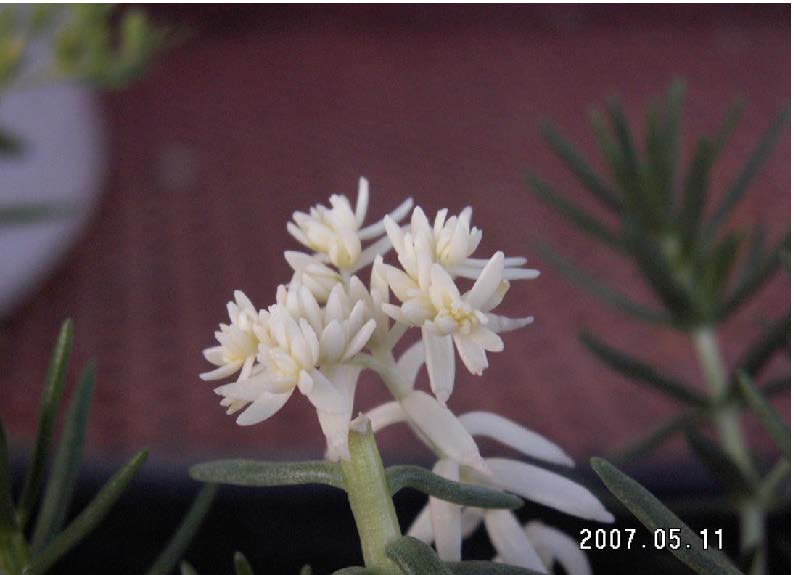
2007年5月11日開花 Flowering on May 11, 2007
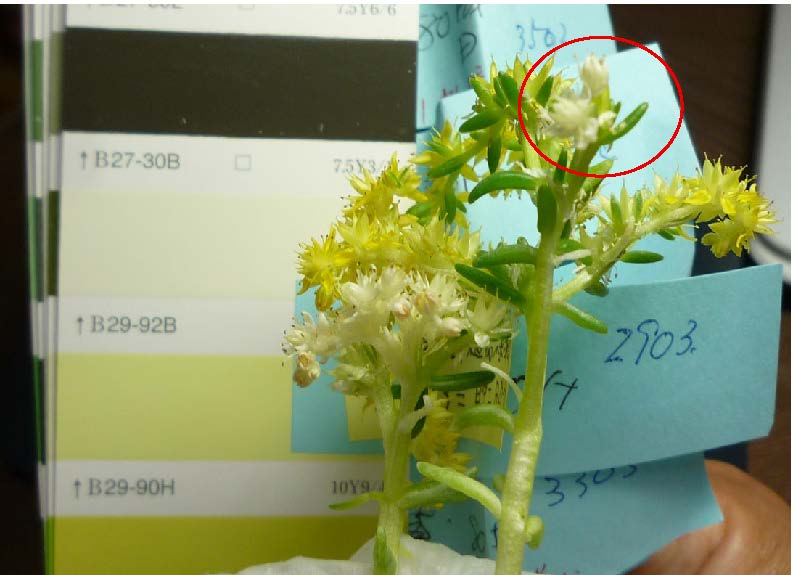
2007年6月22日
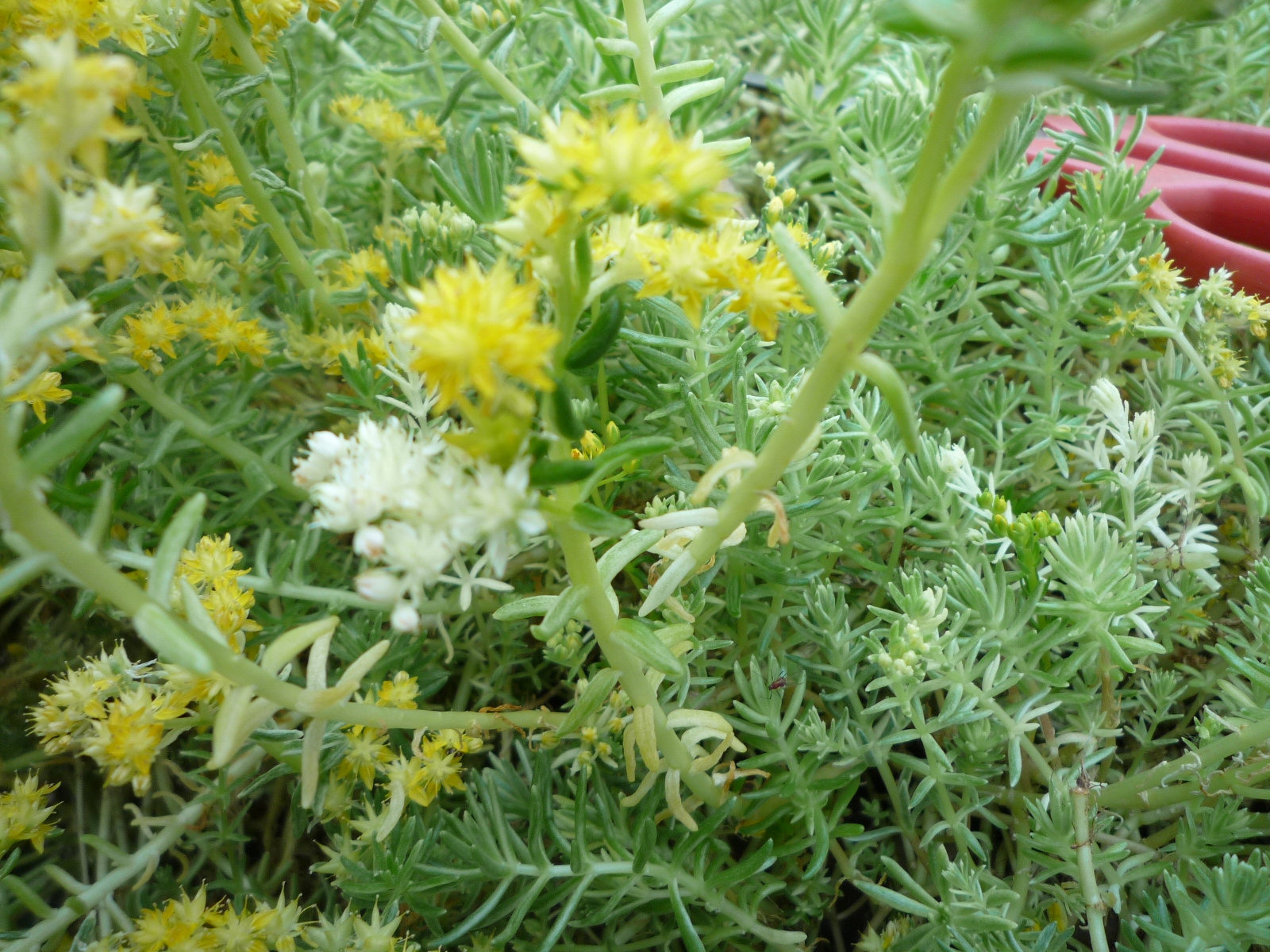

花序の部分開花が白色化する 2017年
Partial whitening of the flower clusters (2017)
2026年5月24日
屋上緑化システム株式会社
技術顧問 山下 律正
May 24, 2026
Rooftop Greening Systems Co., Ltd.
Technical Advisor: Ritsumasa Yamashita


新着記事
キリンソウ・セダム類は漢方薬・食用野菜だった
<実証試験レポート>災害レジリエンス(強靭性)で評価する屋上緑化
<技術レポート> 白花セダムの開発史 キメラ枝からの白花種開発 Development History of White-Flowered Sedum
<技術レポート> 世界初 白花キリンソウ開発情報
幸福緑化 ウェルビーイング薄層屋上緑化のすすめ
〔実用記事〕化学突然変異で景観に優れた新しい草姿のキリンソウ開発する―四季彩キリンソウ開発史―
<技術レポート>四季彩4キリンソウ ー根が露出した状態で2年生存する耐候記録ー
劇的な春の目覚め。進化を遂げた「四季彩4キリンソウ」の色彩
<コラム>中国ドラマに出てくる中国版セダム緑化庭園
<コラム>ベトナム「ダナン・バーナーヒルズ」は巨大な壁面緑化の植物園
屋上緑化・壁面緑化に関するご相談